
In this article
- What is travel business automation?
- Where manual work hides in a travel business
- 1. Capture every enquiry automatically
- 2. Build itineraries from templates
- 3. Follow-ups that send themselves
- 4. Live supplier rates through APIs
- 5. Payments, receipts and reminders
- 6. Vouchers and documents from the booking record
- 7. Let agents book for themselves
- 8. Visa files with checklists and reminders
- Reports without a month-end project
- What to automate first
- Keep the personal touch
- How Ivonix helps travel businesses automate
What is travel business automation?
Travel business automation means letting software handle the repetitive steps between an enquiry and a finished trip: logging leads, building and sending quotes, following up, pulling supplier rates, scheduling payments, issuing vouchers and sending reminders. Your team stops re-typing the same details and spends its time selling and looking after travellers.
Where manual work hides in a travel business
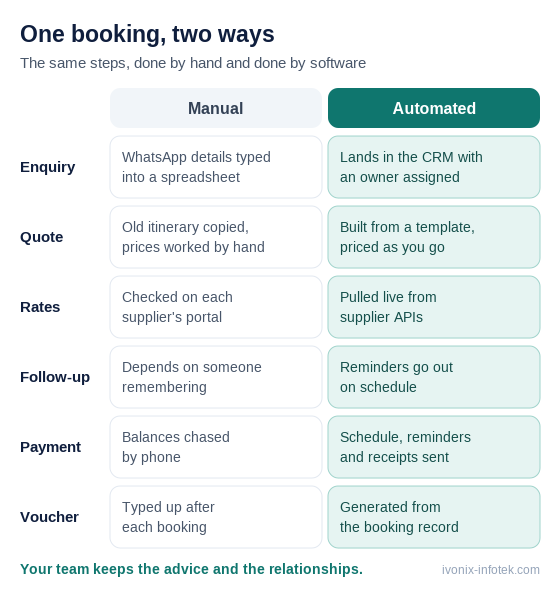
Picture a typical day in a travel agency or tour operator's office. Enquiry details are copied from WhatsApp into a spreadsheet. An old itinerary is opened, edited and re-priced by hand. Someone logs in to three supplier portals to check rates. Payments are chased by phone, vouchers are typed after each booking, and customers call to ask where things stand.
None of these tasks is difficult. Together, they fill a large part of the day, and each one is a chance for a small mistake that a customer will notice.
1. Capture every enquiry automatically
Enquiries arrive from your website, WhatsApp, email, phone calls and agents. With a travel CRM, each one lands in a single list with an owner assigned, so nothing depends on someone copying details across. You can see at a glance which enquiries are new, which have a quote and which are waiting on the customer.
2. Build itineraries from templates
Most travel businesses sell variations of the same popular trips. Instead of copying an old itinerary and recalculating prices, an itinerary builder lets your team start from a template, adjust the days and see the price update as they go. The result goes out as a branded quote, and revisions are saved as versions, so the right one is always sent.
3. Follow-ups that send themselves
A quote that nobody follows up on is often a lost booking. Automatic reminders tell agents when a lead needs attention, and follow-up messages can go out on a schedule. Your team still has the conversations that matter. They just never forget to have them.
4. Live supplier rates through APIs
Copying rates from supplier portals and PDFs is slow, and rates can change before the customer books. Travel API integration brings flight, hotel, sightseeing and transfer availability straight into your system, so quotes use current prices and bookings confirm without re-entering details.
5. Payments, receipts and reminders
Once a booking is confirmed, its payment schedule can be set from the booking itself. The system can remind customers before each payment is due, record what's been received and show the balance outstanding, so nobody keeps a separate sheet or chases payments from memory.
6. Vouchers and documents from the booking record
Hotel vouchers, transfer details and travel documents contain information you already hold in the booking. Generating them automatically saves time after every sale and removes the risk of a typing mistake on a document the traveller relies on.
7. Let agents book for themselves
If you sell through travel agents or sub-agents, every booking call is work your team doesn't need to do. A B2B agent portal lets agents search live rates with their own markup, book within a credit limit and get confirmations straight away, while you track dues and settlements per agent.
8. Visa files with checklists and reminders
Visa work is full of small details: the right documents for each country, appointment dates, passport expiry and fees. Visa management software applies the country's checklist to each traveller's file, shows what's still pending and sends reminders before deadlines, so applications don't stall on a missing document.
Reports without a month-end project
When enquiries, quotes, bookings and payments live in one system, reports come almost for free. You can see margins, conversion and agent performance whenever you want, instead of waiting for someone to combine spreadsheets at the end of the month.
What to automate first
Start with the step that takes the most time or causes the most mistakes. For most travel businesses, that's capturing enquiries and building quotes, because everything else depends on them. Map how the work happens today before choosing software, and fix any steps that don't make sense. Automating a confusing process only makes the confusion faster.
Keep the personal touch
Automation is there to remove repetitive work, not the human side of travel. Travellers still value advice from someone who knows the destination, a call when plans change and help when something goes wrong. When software handles the copying, chasing and typing, your team has more time for exactly those moments.
How Ivonix helps travel businesses automate
Ivonix builds travel software for agencies, tour operators, DMCs and B2B travel companies: a Travel CRM and booking platform, B2B agent portals, itinerary building, visa management and travel API integration. If your workflow needs something different, our travel software development team builds it around the way you work.
Want this working in your business?
Tell us what you are working on and we will show you how it fits. No pressure, no jargon.